
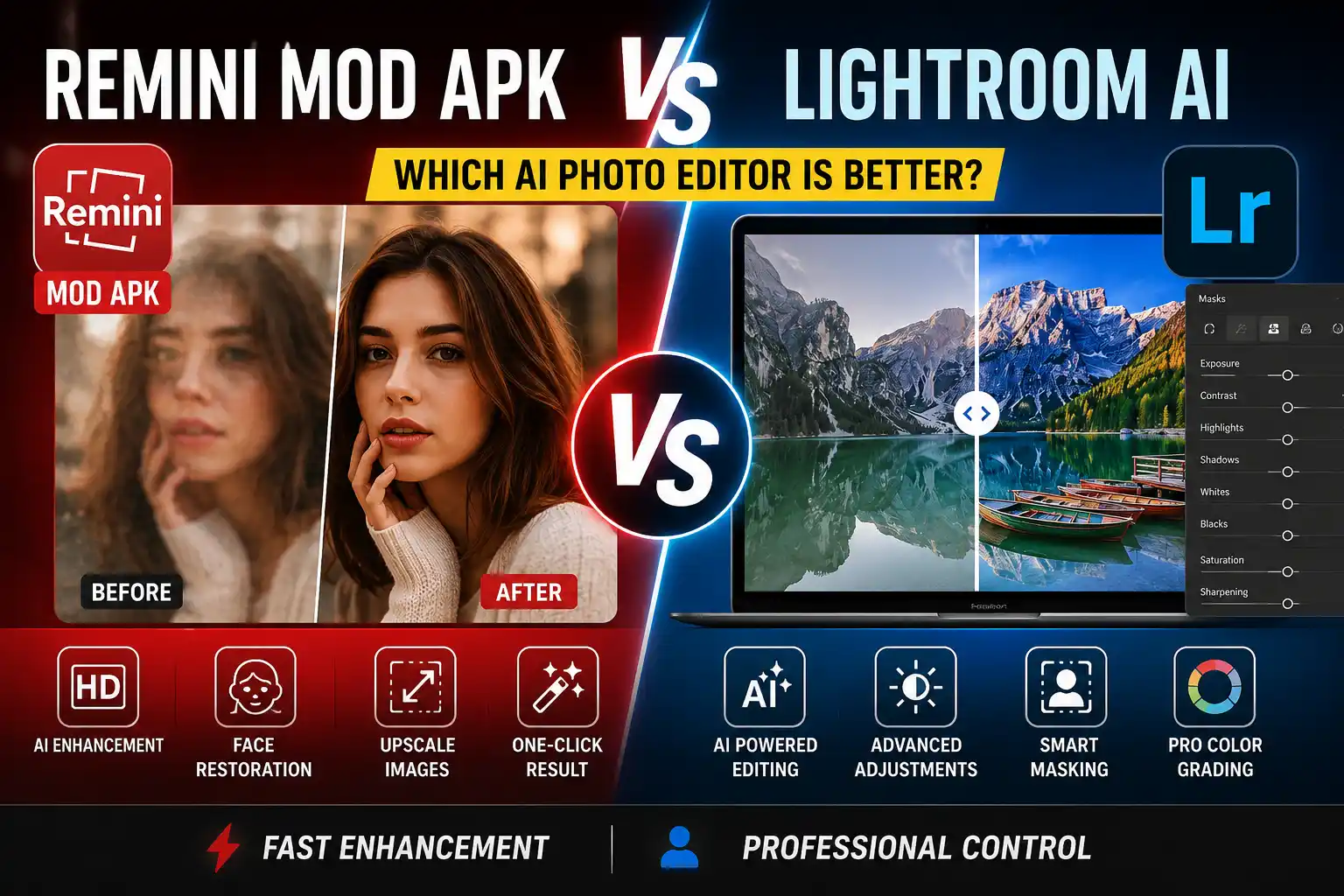
A grainy photo of my dad holding a fish from 1989, a blurry portrait from a candlelit dinner, and a flat landscape from a rainy market day. Those three images sat in my phone, each needing a completely different kind of rescue. I threw all of them at Remini Mod APK and Lightroom AI for weeks. The promise with Remini Mod APK vs Lightroom AI is usually framed as “which app is better?” but that question misses the real problem: these two tools don’t solve the same headaches. One rebuilds lost detail and faces. The other builds a whole editing style around your photos.
I’m not a developer, just someone who edits hundreds of shots every month for personal projects, small gigs, and a family archive that’s half faded prints. The modded Remini came from a friend who swore it “fixed everything.” I ran it on a burner phone, no accounts logged in, and compared every output side by side with Lightroom’s AI features. Here’s what stuck, what failed, and where each tool actually belongs in a real workflow.
The candlelit portrait that taught me the difference in one click
The photo was a mess. My partner laughing across a restaurant table, lit by a single tea candle, shot on an older phone that panicked in low light. The official Remini free version blurred a face ad into it, and the mod unlocked enhancement without the watermark. I tapped Enhance. In three seconds, her eyes were sharp, skin evened out, and the noise vanished. It looked almost like a studio headshot — but a little too perfect. The texture under her eyes disappeared. Her smile stayed, but the natural soft shadows that gave the mood its warmth turned into a flat, smooth mask. If I needed a profile picture instantly, I’d use it and not look back.
That same evening, I pulled the raw file into Lightroom mobile. AI subject masking selected her face and body with one tap. I gently raised sharpness and texture on the eyes, cooled the shadows slightly, and let the candle’s warm tone stay on the skin. No waxy finish. The final image still felt like that dinner, not a retouched ad. For me, that’s the dividing line: Remini Mod APK saves a broken shot; Lightroom AI polishes a memory without erasing the atmosphere.
The 1989 fish photo and the restoration reality check
My dad’s old print — faded, a crease across the corner, colors washed into a yellowish soup — was exactly the kind of project that makes people hunt for a Remini Mod APK download. I scanned it at 600 DPI, loaded it into the mod, and let the enhancement run. The AI rebuilt his face: the squint, the cap, even added a plausible eye glint that wasn’t visible in the original. Colors came back automatically. The sky turned a believable pale blue. The fish looked, well, like a fish. My mother said “that’s exactly the shirt he wore.”
A couple of tries showed me a quirk no top-ranking article mentions: if the face is tiny in the frame, Remini sometimes invents facial details. One version gave him a second catchlight that made his expression look oddly startled. It’s a reminder that the AI is guessing. I kept the best output, but I’d never run the only copy of a priceless photo through a mod that might crash halfway or produce a weird artifact without warning.
Lightroom couldn’t reconstruct the face. But it did help me build a cleaned-up version manually: denoise reduced the grain, a graduated filter pulled some blue back into the sky, and a subtle vignette framed him nicely. It took fifteen minutes, not three seconds. The result looked like a restored print, not an AI recreation. For archival work where authenticity matters more than a wow factor, I now lean on Lightroom first and treat Remini’s restorations as a fun “alternate reality” version.
The rainy market shot and why AI masking changes everything
I shot a near-empty vegetable market on a wet Tuesday. The original photo was flat — gray sky, muddy greens, zero pop. I wanted something moody and cinematic. Lightroom’s adaptive presets analyzed the scene and gave me a deep, teal-orange look that darkened the pavement while keeping the red chilies vivid. The preset didn’t just slap a filter on; it knew the sky was sky and the veggies were foreground subject. I tweaked the mask on the stall owner to stay naturally lit. That kind of selective edit is impossible in Remini, which doesn’t offer masking or any control over the final look. Its filters are either AI Avatar artwork or a generic enhancement. The market photo would have come out sharper in Remini, yes, but completely unstyled.
If you’re trying to build a recognizable grid on Instagram or a portfolio with a consistent color story, Lightroom AI is the tool that learns your taste. The modded Remini doesn’t learn anything; it just re-runs the same enhancement model every time.
Video upscaling and the mobile gig test
I occasionally shoot short video clips at local community events — a parade, a dance performance — and one low-light clip from a fundraiser looked rough. Remini Mod APK promises video enhancement with the pro unlock, so I fed it a 720p clip. The output was sharper, and faces in the crowd became recognizable. The process, though, was slow, the phone got hot, and the app crashed once mid-processing. The result was usable for social media stories but not something I’d send to an organizer for promotional use.
Lightroom doesn’t do video. So this isn’t a comparison, it’s a gap. If video upscaling matters, Remini (even the mod) fills a need that Lightroom ignores. But I’d only run it on a secondary device, and I’d keep the original file safe because the mod’s stability is inconsistent.
The elephant that most articles skip: safety, updates, and the missing undo button
I used the mod for a month, fully aware that an unofficial APK from a random site isn’t a smart long-term partner. No update means any server-side change by Remini could break it overnight. It requested permissions that felt unnecessary — access to media, yes, but also location and device info. I never logged into any personal accounts on that phone. Even then, the idea of running it on my daily driver with banking apps nearby felt wrong.
Lightroom’s free tier gives you AI masking, adaptive presets, profile-based lens corrections, and basic editing — all legally, with regular updates and no malware scare. The premium plan adds healing brushes and cloud sync, but you can do a lot without paying. If someone just wants quick face fixes and understands the risks, the mod has its place. But I’ve seen too many people install cracked software on their main phone and then wonder why their photos mysteriously appear elsewhere. That’s not paranoia; it’s just a reality of unverified code.
How I’d pair them for a full real-world workflow
After a family reunion, I had a mix of sharp phone photos, a few blurry candids, and scanned film prints from a cousin. I ran the blurry ones through Remini (on that isolated device) just to salvage faces, then moved everything to Lightroom. From there, I applied a vintage Kodachrome-inspired preset with AI masking to pop the subjects without affecting the already restored faces. The final album looked cohesive — sharp where it needed to be, atmospheric everywhere else. That hybrid flow, however, only works if you accept that Remini is a salvage tool, not a style tool.
Beginners often think one app will do it all. My own early mistake was expecting Remini to make a photo beautiful in the same way Lightroom does. It doesn’t. It fixes technical flaws. Lightroom interprets mood. Understanding that difference saves hours of frustration and prevents plastic-looking feeds that scream “over-processed.”
What about skin tones and ethnic accuracy?
This rarely gets mentioned in comparison posts. Remini’s face enhancement model sometimes lightens darker skin tones or smooths out natural highlights in a way that feels off. I tested it on a portrait of my friend with deep brown skin under warm street lights. The mod’s output made her complexion a couple of shades lighter, losing the richness. Lightroom’s subject mask let me keep the exposure and warmth exactly where they belonged. I could selectively brighten her eyes without altering skin tone. For photographers who care about authentic representation, that’s a dealbreaker. Remini’s one-click fix doesn’t give you a say.
Frequently Asked Questions
Can I use Remini Mod APK to enhance a whole album at once?
No. Remini doesn’t support batch processing. You enhance one image or video at a time, which gets tedious fast.
Does Lightroom AI work on very old black-and-white photos?
It can help clean up grain and adjust contrast, but it doesn’t automatically reconstruct faces or colorize. You’ll get a cleaner monochrome image, not a modernized recreation.
Will the mod version of Remini give me the same results as the official premium version?
Mostly yes, as long as the servers process your request the same way. But without updates, you might miss newer AI models or risk that the app gets blocked entirely.
Is Lightroom’s AI masking good enough for product photography?
Absolutely. I use it to isolate products on white backgrounds and tweak shadows without affecting the backdrop. It’s incredibly precise for e-commerce and portfolio shots.
What happens if the Remini mod stops working mid-restoration?
You could lose the processed image. That’s why I always run it on a copy, never the original file, and save manually after every successful enhancement.
Which tool is better for a beginner who just wants better-looking travel photos?
If the photos are sharp but lack mood, go with Lightroom AI. If the photos are actually blurry or low-resolution, Remini can make them usable — but expect a hyper-crisp, sometimes artificial look.